The Eternal Lotus: Sunayana Malhotra's Contemporary Vision
Beneath the recognisable flower lies an accomplished abstract painter. Her lotus is no longer merely a flower — it is a living metaphor for memory, spirituality and inner stillness.
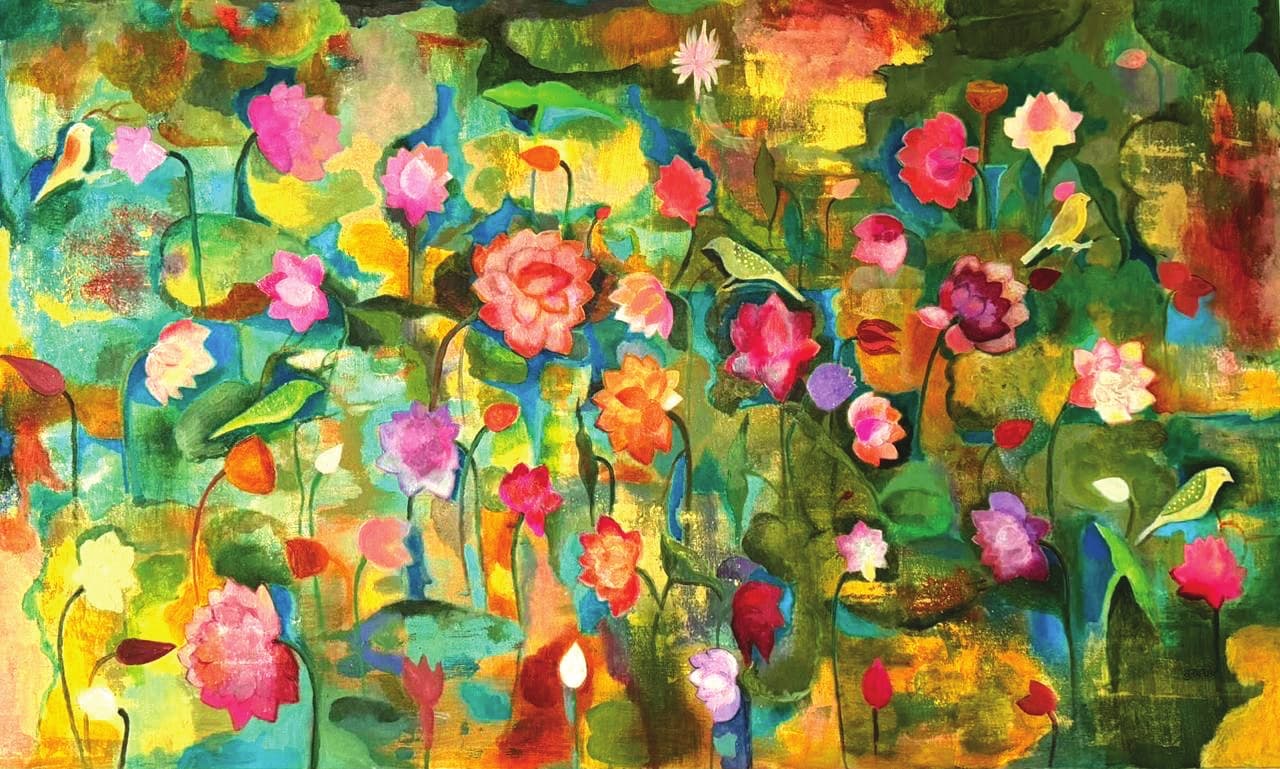
Blending abstraction with symbolism, Sunayana Malhotra has developed a distinctive artistic language where colour, texture and spirituality converge — transforming the lotus into a timeless metaphor for contemplation, renewal and inner consciousness.
Every artistic language is shaped through years of experimentation, refinement and discovery, and Sunayana Malhotra's practice is no exception. Although she is now widely recognised for her evocative lotus paintings, her artistic journey extends far beyond a single motif.
Over the years, Malhotra has cultivated a confident vocabulary of abstraction, exploring the expressive potential of colour, texture, rhythm and layered surfaces. Her paintings reveal an intuitive understanding of atmosphere, where emotion often takes precedence over description. This fluency continues in every canvas she creates, lending her work a quiet sophistication and unmistakably contemporary sensibility.
The lotus, however, became the visual language through which these explorations reached their fullest expression. Rather than narrowing her practice, it provided the artist with an enduring metaphor through which she could investigate memory, spirituality, nature and human consciousness. What distinguishes Malhotra's oeuvre is that the lotus is never repeated as a decorative formula. Instead, each painting reinterprets the motif through evolving colour harmonies, shifting spatial relationships and increasingly nuanced emotional registers.
The eternal bloom
In the long and layered history of Indian art, few motifs have endured with the spiritual resonance and visual richness of the lotus. Emerging pristine from muddy waters, it has long symbolised purity, transcendence, renewal and enlightenment. From the sculptural traditions of Sanchi and Ajanta to Mughal miniatures, Rajput painting, the Bengal School and contemporary abstraction, the lotus has remained one of India's most enduring visual metaphors.
| Modern master | The lotus in their work |
|---|---|
| Rabindranath Tagore | Transformed the lotus into a symbol of cultural identity and spiritual renewal. In Bharat Mata it embodies purity, national consciousness and the soul of India. |
| Nandalal Bose | Drew from mythology and nature, using the lotus in restrained, lyrical forms that reinforced its place in India's modern artistic vocabulary. |
| Jamini Roy | Reinterpreted the lotus through the language of folk art, reducing it to bold, stylised forms balancing decorative appeal with symbolic depth. |
| M. F. Husain | Infused the lotus with expressive energy, weaving it into his dynamic explorations of Indian mythology, history and spirituality. |
| S. H. Raza | Elevated the lotus beyond representation, treating it as a metaphysical symbol of cosmic energy, meditation and inner awakening. |
The lotus reimagined
Rather than treating the lotus as a botanical subject, Malhotra transforms it into an expansive emotional landscape where memory, mythology, meditation and abstraction coexist. Through luminous colour, layered textures, floating birds, meditative silhouettes and dreamlike atmospheres, her paintings occupy a distinctive place within contemporary Indian art — deeply rooted in cultural memory yet unmistakably modern in expression.
The significance of the lotus within Indian philosophy is inseparable from its artistic history. In Hindu thought it embodies creation, purity, prosperity and wisdom through its associations with Brahma, Lakshmi and Saraswati. Buddhism regards the lotus as a metaphor for spiritual awakening, while Jain traditions recognise it as an emblem of transcendence. Malhotra does not replicate these traditions; she extends them. Her lotus is not an illustration of mythology but a contemporary meditation upon it.
“The lotus becomes less a flower than a state of mind — an enduring metaphor for reflection, renewal and inner stillness.”
Layering as a meditative process
A defining characteristic of Malhotra's work is her mastery of layered surfaces. Transparent washes merge with opaque passages, while textures, patterns and fragments of ornament quietly emerge from beneath the paint. The process resembles an archaeological excavation, where each layer preserves traces of previous decisions and histories. Decorative references to textiles, sacred geometry and architectural ornament often remain partially concealed, creating paintings that function as visual palimpsests. This gradual accumulation mirrors meditation itself — an unfolding process of reflection rather than revelation.
Colour as emotional language
If layering forms the structure of Malhotra's paintings, colour provides their emotional resonance. Rather than describing nature realistically, she constructs immersive atmospheres through carefully orchestrated palettes of turquoise, emerald, ochre, saffron, crimson, coral, lavender and luminous gold. Cooler works evoke the serenity of temple ponds at dawn, while warmer compositions radiate transformation and spiritual energy. Colour is never merely decorative; it shapes movement, establishes mood and dissolves the boundaries between representation and abstraction, giving her paintings a lyrical, almost musical quality.
Silence, birds and the Zen imagination
Birds appear repeatedly throughout Malhotra's paintings, introducing a subtle dialogue between earth and sky, rootedness and freedom. Within Indian and Eastern philosophies they symbolise consciousness and spiritual ascent, complementing the lotus's association with awakening. Together these motifs create paintings that resist narrative in favour of presence. Much like Zen gardens, they encourage contemplation over interpretation, where silence becomes as significant as imagery and empty spaces carry as much meaning as painted forms.
Ancient symbol, contemporary voice
Malhotra's engagement with mythology is understated yet profound. Rather than illustrating sacred stories, she absorbs their philosophical essence into her visual language. Buddha-like silhouettes, meditative figures and recurring lotus forms function as contemporary mandalas, balancing abstraction with cultural memory. This ability to negotiate tradition without becoming nostalgic distinguishes her practice. Her paintings remain unmistakably Indian while speaking to universal themes of resilience, renewal and inner transformation.
Beyond beauty
The immediate appeal of Malhotra's work lies in its luminosity and elegance, yet its lasting strength resides in its intellectual and emotional depth. Questions of impermanence, ecology, spirituality and memory gradually reveal themselves through sustained viewing. This layered quality has also contributed to the growing appreciation of her work among collectors. As global interest continues to expand for artists who reinterpret cultural heritage through contemporary expression, Malhotra's paintings occupy a compelling position — resonating equally within private collections, hospitality projects, wellness spaces and corporate environments.
A collector's perspective
For discerning collectors, the appeal of Sunayana Malhotra's work extends far beyond its visual beauty. Her paintings embody the qualities that define enduring artistic practices: a distinctive visual language, conceptual coherence, technical sophistication, and a rare ability to evolve while remaining unmistakably her own. The lotus has become the artist's unmistakable signature, yet no two works feel alike. Each canvas offers a fresh dialogue between colour, texture, atmosphere and symbolism, revealing a practice that values exploration over repetition.
Equally compelling is the universal relevance of her imagery. Rooted in India's philosophical traditions yet expressed through a contemporary painterly language, Malhotra's works resonate across cultures, making them equally at home in private collections, institutional settings and thoughtfully curated interiors. Ultimately, collectors are drawn not only to what these paintings depict, but to the contemplative experience they offer.
Her lotus is no longer merely a flower; it is a living metaphor, one that continues to bloom with grace, contemplation and quiet originality.