Beyond the Surname: Not Every Political Heir Deserves Contempt
Few object when an industrialist's child inherits a business empire. If business acumen is not encoded in one's genes, why is political inheritance automatically equated with incompetence?
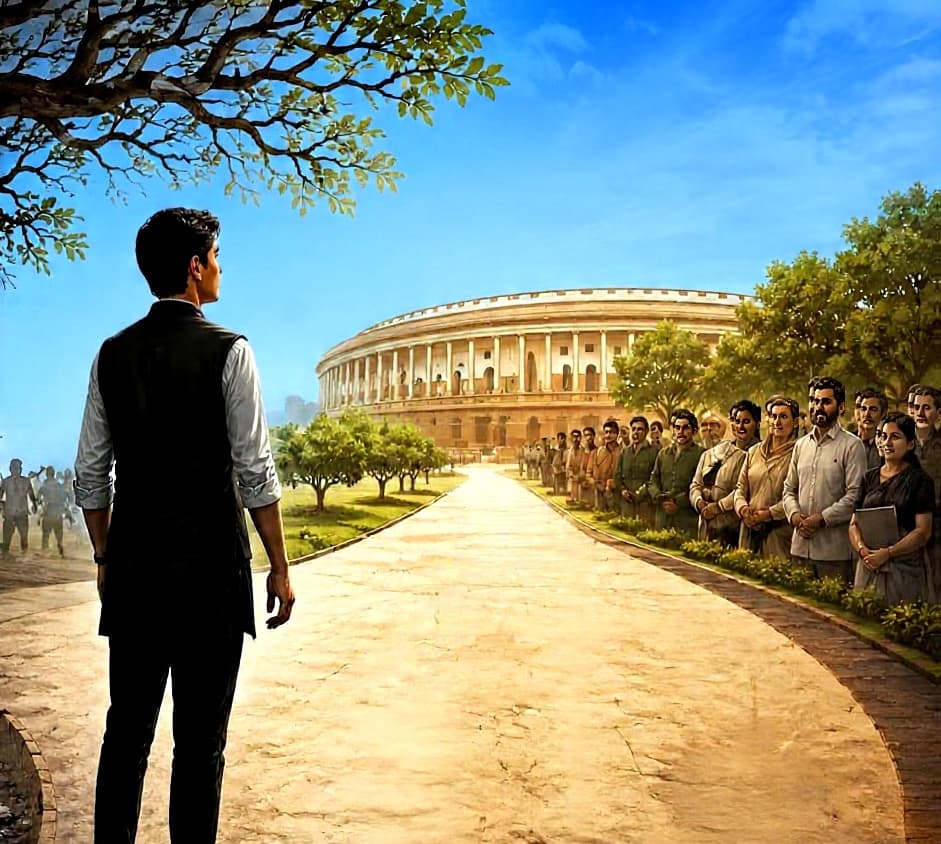
Indians rarely agree unanimously on political issues. Yet there is one subject that almost invariably provokes outrage across party lines: dynastic politics.
For many, merely being the son, daughter, spouse or relative of a politician is treated as a disqualification in itself. The cry of "family rule" or "nepotism" rises instantly whenever a political heir enters public life. Curiously, the same standard is seldom applied elsewhere. Few object when the child of an industrialist inherits a business empire, or when a family-run enterprise passes from one generation to the next.
If business acumen is not encoded in one's genes, why is political inheritance automatically equated with incompetence? The real question is not whether a person belongs to a political family. The real question is whether that individual possesses the ability, experience and commitment required for public service.
Politics runs in families everywhere
Political families are hardly unique to India. Across the world, politics often runs in families. Former Canadian Prime Minister Justin Trudeau followed in the footsteps of his father, Pierre Trudeau, one of Canada's most influential leaders, who helped shape modern Canada through the Charter of Rights and Freedoms and by institutionalising bilingualism. In the United States, the Kennedy family has been a powerful political force for generations. Similar examples can be found across Europe, Asia and Latin America.
Yet it would be simplistic to assume that every child of a politician is automatically qualified for public office. Just as the children of doctors, lawyers or engineers do not necessarily inherit their parents' professional abilities, political talent too cannot be assumed. A famous surname may open doors, but it cannot guarantee competence.
Two types of political dynasts
Broadly speaking, political heirs fall into two categories. The first consists of individuals who are elevated primarily because of their family name. Their rise often breeds resentment among party workers and leaders who have spent years building grassroots support and organisational experience.
The debate over dynastic politics in India has largely centred on the Nehru-Gandhi family. From Jawaharlal Nehru and Indira Gandhi to Rajiv Gandhi, Sonia Gandhi, Rahul Gandhi and Priyanka Gandhi Vadra, successive generations have exercised immense influence over the Congress Party. Critics argue that leadership based predominantly on lineage can discourage merit and weaken organisational vitality.
However, dynastic politics is by no means confined to the Congress. India's political landscape is replete with examples: Devi Lal and Om Prakash Chautala in Haryana; Chaudhary Charan Singh and Ajit Singh in western Uttar Pradesh; Hemwati Nandan Bahuguna and Rita Bahuguna Joshi; Rajesh Pilot and Sachin Pilot in Rajasthan; and, more recently, Mamata Banerjee's efforts to promote her nephew Abhishek Banerjee as a future leader in West Bengal. Political succession is a phenomenon that cuts across party lines and ideological divides.
The Scindias: a dynasty like no other
Few families illustrate the complexities of Indian dynastic politics better than the Scindias of Gwalior. Rajmata Vijaya Raje Scindia was a founding figure of the Bharatiya Janata Party. Her daughters, Vasundhara Raje and Yashodhara Raje Scindia, became prominent BJP leaders, with Vasundhara serving twice as Chief Minister of Rajasthan. Yet her son, Madhavrao Scindia, charted a very different course, becoming a senior Congress leader and close associate of Rajiv Gandhi.
The story became even more intriguing with the next generation. Madhavrao's son, Jyotiraditya Scindia, entered politics through the Congress, served as a Union minister, and later switched to the BJP, dramatically altering the political landscape of Madhya Pradesh. Few political families have spread their influence so widely across rival political camps.
Growing up in politics
The second category of political heirs deserves a more nuanced assessment. These are individuals who spend their formative years immersed in politics. They accompany their parents on constituency visits, attend public meetings, interact with party workers, listen to public grievances and observe governance at close quarters. For them, politics is not a sudden career choice. It is an environment in which they have lived and learned for decades.
Akhilesh Yadav is a notable example. Groomed under the guidance of Mulayam Singh Yadav, he developed his own political identity and emerged as a significant force in Uttar Pradesh politics. Others include Abhishek Banerjee, Piyush Goyal, Vijay Goel, Bansuri Swaraj, Sandeep Dikshit, Ajay Maken and M. K. Stalin. Whatever one's political preferences, these leaders spent years understanding political organisation, public engagement and electoral realities before assuming major responsibilities. To dismiss such individuals solely because of their surnames is neither fair nor particularly rational.
Experience matters
Experience has value in every profession, and politics should be no exception. If someone has spent twenty or thirty years observing governance, understanding constituency dynamics and learning the practical realities of public life, should that accumulated knowledge be disregarded simply because of an accident of birth? Many political heirs begin their careers with a deeper understanding of public administration, policy-making and voter expectations than complete outsiders. This exposure does not guarantee success, but it certainly provides valuable preparation.
The real threat to democracy
The greater danger to democracy does not necessarily come from political families. A political heir, whatever his or her background, remains accountable to voters and must periodically seek a public mandate. The more serious threat comes from individuals who possess neither political experience nor a record of public service, yet acquire influence through wealth, corporate power, caste arithmetic, religious polarisation or sheer opportunism.
“Democracy is weakened not by lineage alone but by the absence of competence, accountability and commitment.”
Society rarely objects when business families produce successful entrepreneurs generation after generation. No one suggests that the child of a renowned surgeon should be barred from medicine. Film families have produced some of India's finest actors, while sporting families have produced champions in successive generations. In every field, exposure, mentorship and early learning matter. Why should politics alone be judged by a different standard?
The reality is that a surname may provide visibility, but it cannot ensure public acceptance. Indian voters have repeatedly demonstrated their willingness to reject even the most prominent political families when performance falls short. Democracy itself is the ultimate filter.
Politics, like any serious profession, requires training. Some acquire that training through student movements, grassroots activism and years of organisational work. Others acquire it by growing up in political households and spending decades learning the craft from close quarters. Both routes are legitimate. Our obsession with surnames often distracts us from the more important question: has the individual earned the trust of the people? Ultimately, voters do not elect parents; they elect individuals.
In a democracy, the test should never be lineage alone. The test should be competence over prejudice, experience over envy, and service over surname.