The Rise, Fall & Rise of Gautam Adani
From modest roots to global infrastructure titan, Gautam Adani's saga spans a meteoric rise, near-collapse, legal battles, and a $100B AI pivot — reclaiming Asia's richest crown.

Gautam Adani, or Gautam Bhai as he is fondly called, is the founder and chairman of the Adani Group, a sprawling infrastructure conglomerate that serves as the literal and metaphorical engine of modern India. Yet, his story is not merely one of balance sheets and infrastructure; it is an epic tale of survival, strategy, and controversy.
Few business stories in modern India are as dramatic and compelling as that of Gautam Adani. His journey reads like an extraordinary cinematic saga — a young man from a modest background rising to command one of the world's largest infrastructure empires, facing devastating setbacks that threatened to destroy everything, and then scripting a remarkable comeback.
Honestly, if Indian corporate history were a cinematic universe, Gautam Adani's character arc would defy the imagination of the most ambitious screenwriters. His narrative mirrors the high-stakes drama of classic Indian cinema — the gritty underbelly of Mumbai, the razor-sharp ambition of a young outsider, the breathtaking ascent to global power, an existential crisis that wiped out billions in days, and a spectacular script rewrite that pulled him back from the edge.
The Present Tense: Reclaiming the Crown
The current chapter of Adani's life reads like the triumphant climax of a sequel. He was accused of having raised money in the US to bribe politicians and bureaucrats back home — a case which he has managed to settle by agreeing to spend upwards of 10 billion dollars in the US as investment. He roped in the lawyer who used to appear for Donald Trump. So the sword of him facing the massive embarrassment of a warrant from US courts has now disappeared.
He has reclaimed his position as Asia's richest individual, with a net worth hovering around $92.6 billion, placing him 19th globally and once again surpassing his long-time contemporary, Mukesh Ambani.
Even during the worst period of his life, Gautam Adani has never played on the defensive. His group has expanded aggressively. Adani Ports recently executed a ₹1,500 crore acquisition of Jaypee Fertilizers, building out its inland logistics network. Simultaneously, the group committed a staggering $100 billion to sovereign AI infrastructure, pivoting from old-world industrial infrastructure (coal, cement, ports) to the digital landscape of the future.
The Origin Story: From Diamond Dust to "Guru"
“Born into a middle-class Gujarati family, Adani showed little interest in his father's textile business. He always possessed an innate, aggressive entrepreneurial instinct that could not be taught in a classroom.”
To understand how he reached these heights, one must travel back to Ahmedabad in the late 1970s. Born into a middle-class Gujarati family, Adani showed little interest in his father's textile business. He always possessed an innate, aggressive entrepreneurial instinct that could not be taught in a classroom. I remember meeting him in 2013 when he wasn't what he is today. The just-born Aam Aadmi Party was targeting its guns on the Ambani-Adani duo, and the media was having a field day at Gautam Bhai's expense. I was keen to interview him. He agreed, but had a condition: that I must first go and see the port he had built in Mundra. When I went to see the port, I was indeed awestruck with his imagination — his ability to think on a scale. He narrated to me his early days: how he would travel between Ahmedabad and Mumbai in a way that he would not need to spend on hotel rooms, ending up spending his late night or early morning on the railway platform itself.
He dropped out of commerce college and arrived in Mumbai with nothing but a few hundred rupees in his pocket. Instead of seeking safety, he threw himself into the fast-paced world of diamond sorting at Mahendra Brothers. Within a few years, a teenage Adani had mastered the trade and established his own diamond brokerage.
The true turning point came in 1981, when his elder brother called him back to Ahmedabad to manage a newly acquired plastics factory. This required importing Polyvinyl Chloride (PVC) — a gateway into global trade. By 1988, he established Adani Exports (now Adani Enterprises), trading in agricultural and power commodities.
The Cinema Analogy
If his early life could have been based on Mani Ratnam's Guru, his mid-career was pure Deewaar. He survived a kidnapping for ransom in 1998 and walked out of the Taj Mahal Palace Hotel during the horrific 26/11 terror attacks in 2008. He is a man who has repeatedly stared into the abyss, brushed off the dust, and returned to the boardroom.
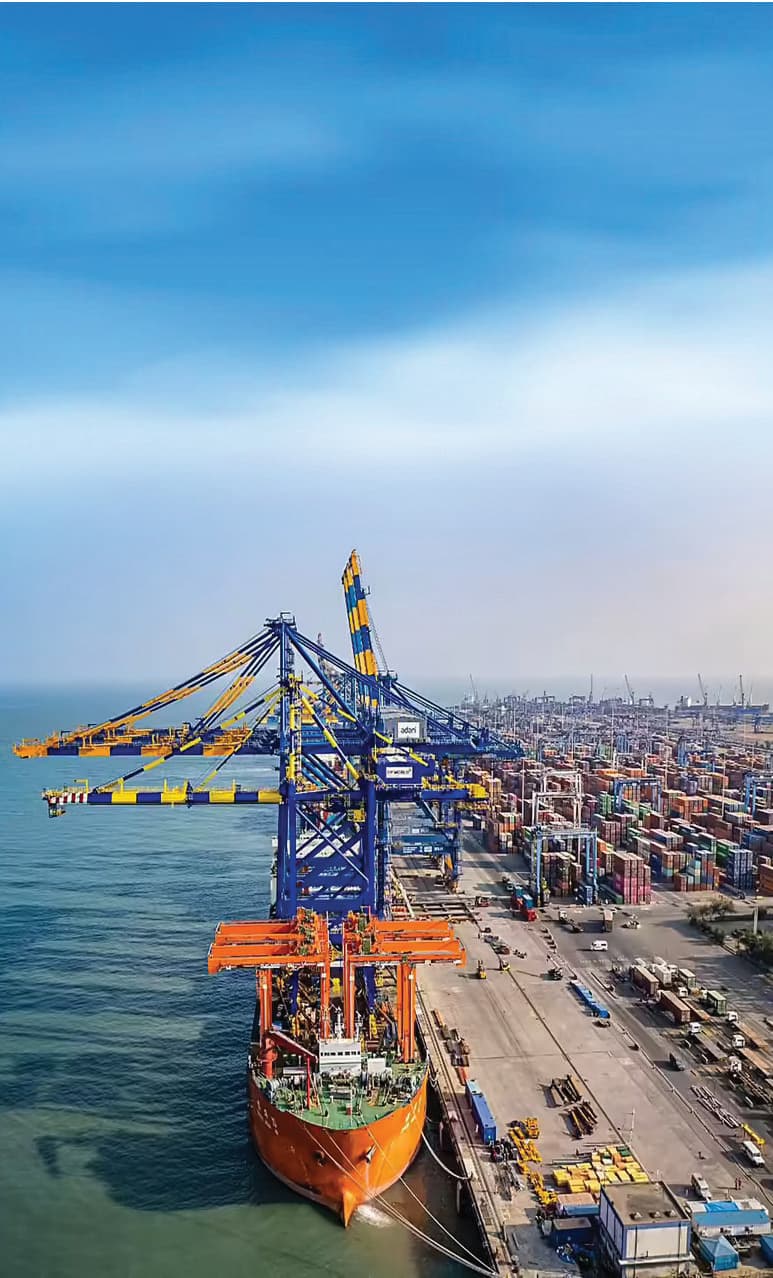
His business model today acts as a proxy for India's GDP. If India builds roads, it uses Adani cement. If it imports goods, they land at Adani ports. If it turns on the lights, the electricity flows through Adani transmission lines.
The Lightning Rod: Controversy and the Hindenburg Storm
Yet, this hyper-alignment with the state is precisely what makes him highly controversial. Critics routinely accuse Adani of being the ultimate poster child for crony capitalism, pointing to his close relationship with Prime Minister Narendra Modi, a bond forged in Gujarat during the early 2000s. Critics argue that his rapid acquisition of national infrastructure assets — such as the rules relaxed to allow his group to bid for multiple airports simultaneously — stifles competition.
This criticism turned existential on January 24, 2023. A New York-based short-seller, Hindenburg Research, published a scathing report accusing the Adani Group of "the largest con in corporate history," alleging brazen stock manipulation and accounting fraud through a labyrinth of offshore shell entities.
“Adani's personal net worth plummeted, knocking him from the world's 3rd richest man to 22nd. The group had to abruptly pull a fully subscribed ₹20,000 crore Follow-on Public Offer (FPO) to protect retail investors — a massive blow to his corporate prestige.”
The fallout was catastrophic — a corporate thriller come to life. Within weeks, the group's listed stocks plummeted by up to 60-70%. Adani's personal net worth plummeted, knocking him from the world's 3rd richest man to 22nd. The group had to abruptly pull a fully subscribed ₹20,000 crore Follow-on Public Offer (FPO) to protect retail investors — a massive blow to his corporate prestige.
The Brain Trust: Adani's Key Strategists
The Adani family is a very close-knit group. Through all the crises, it's this group which keeps the business going.
Rajesh Adani (Brother): The operational backbone of the family. While Gautam focuses on vision and macro-strategy, Rajesh manages execution and the complex supply chains of the group's trading operations.
Pranav Adani (Nephew): Managing Director of Adani Agro and Oil & Gas, Pranav represents the sophisticated, modern face of the family, leading the group's massive consumer-facing ventures and urban real estate redevelopments.
Jugeshinder "Robbie" Singh (Group CFO): The financial architect. Known for his blunt, sharp intellect, Singh is the man who engineered the group's capital management framework, successfully steering the ship through the turbulent waters of Wall Street skepticism during the Hindenburg crisis.
Aman Singh: A former bureaucrat from Chhattisgarh — but someone who flies across the world to manage crisis situations for the Adani enterprise.
The Script Rewrite: How the Empire Fought Back
Many predicted the collapse of the Adani empire, but they underestimated his capacity for crisis management. Adani launched a calculated, multi-step counter-offensive to win back global capital markets.
De-leveraging Debt: The group rapidly prepaid over $2 billion in share-backed loans, soothing nervous Western banks.
Securing Anchor Investors: He brought in prestigious international investors like GQG Partners, who bucked the trend by buying stakes worth billions in Adani companies during the nadir of the crisis. More recently, global funds like Temasek and Alpha Wave have eyed a $1.3 billion consortium stake in Adani Airports.
The Legal Clean Chit: The Supreme Court ruled that there was no regulatory failure by SEBI, dismissing petitions that demanded an expedited, external investigation.
To top it all, Hindenburg itself decided to close down its investigative reportage business as it faced a slew of litigation from the Adani enterprises. Group CFO Jugeshinder "Robbie" Singh even took to social media to mock the short-sellers' retreat, writing a cryptic, defiant note: "Kitne Ghazi aaye, kitne Ghazi gaye."
Conclusion: The Unwritten Finale
“Gautam Adani's life cannot be measured by a standard corporate yardstick. He is a survivor of kidnappings, terror attacks, political shifts, and Wall Street short-sells.”
Gautam Adani's life cannot be measured by a standard corporate yardstick. He is a survivor of kidnappings, terror attacks, political shifts, and Wall Street short-sells. He has built a legacy anchored so deeply into the bedrock of this nation's economy that his financial health is inextricably tied to the rise of India itself.
The real reason for his consistent success perhaps comes from his political astuteness. While many look at him purely as a poster boy of the BJP and Narendra Modi, his political relationships are all across — from Ashok Gehlot in the Congress to Sharad Pawar in the NCP. While speaking at a function in Mumbai last year, when Rahul Gandhi was attacking him on a regular basis, Adani made it a point to credit former PM Manmohan Singh as one of the people who inspired him and helped him the most.
Now, as he guides his next generation into his family business, perhaps there is still a final hurrah somewhere for Gautam Adani. What will it be? Well, one thing is for sure: it will remain a headline creator. That's been the life of Mr Adani, always.